
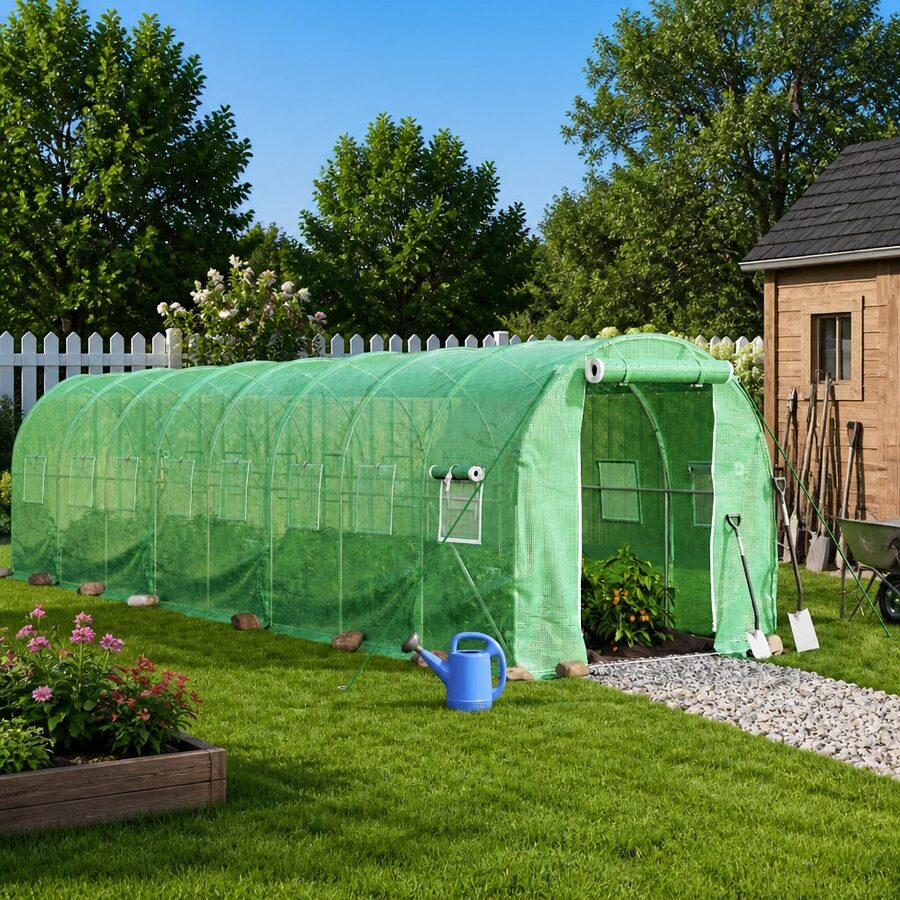
A customer rang us last spring asking why a “44 square metre greenhouse” looked like a long skinny tunnel in the photos instead of a square shed. Fair question. Once you do the maths — 22 metres long, 2 metres wide, 2 metres high — it makes sense. This isn’t a glasshouse you’d picture from a cottage garden magazine. It’s a long, narrow steel-framed tunnel built to run down a side yard, along a fence line, or across the back of a suburban block where width is the one thing you don’t have much of.
If you’re new to steel frame PE cover greenhouses, here’s what that size actually means for your garden, how the structure holds up, and where it fits compared with smaller tunnel houses and indoor grow tents.
What “44m² steel frame PE cover” actually describes
Break the name down and it tells you almost everything:
- Steel frame — galvanised or powder-coated steel tubing forms the arched ribs and ridge, bolted or clipped together. This is what carries wind and snow load, not the plastic.
- PE cover — polyethylene sheeting, usually UV-stabilised, stretched over the frame and tied down with straps or built-in clips. It’s the same family of plastic used in tarps and shade cloth, chosen because it’s light, cheap to replace, and lets diffused light through without cooking your seedlings.
- 44m² — the floor area, not the growing capacity. At 22m long and 2m wide you get a single central path with garden beds or staging on either side, which is exactly how most backyard growers use it.
- 2m height — enough to walk upright through most of the tunnel, though the sides curve down, so tall plants do best in the middle third.
The 44m² Greenhouse (22x2x2m) is this exact setup — a long steel-ribbed tunnel with a green PE skin, designed to be assembled in sections along its length rather than as one big span.
Why the shape is long and narrow, not square
A lot of first-time buyers assume 44m² should look roughly square, like a 6.6m x 6.6m room. Steel frame tunnel greenhouses almost never work that way, for a practical reason: the arch design that makes them strong and cheap only really works efficiently up to about 3m wide. Go much wider than that without extra internal bracing and the frame needs heavier steel to resist wind lift, which pushes the price up fast.
So manufacturers keep the width modest — 2 to 3.5m is typical — and add length instead by repeating the same steel hoop every 60-100cm down the run. That’s why this model is 22 metres long. It’s cheaper to build, easier to ship flat-packed, and easier for one person to erect section by section over a weekend, rather than needing scaffolding for a wide-span structure.
Where a 22m tunnel actually fits
- Down a side passage or along a back fence on a standard suburban block
- Across an allotment or hobby farm row where you’re growing in long beds anyway
- Replacing several smaller cold frames with one continuous structure
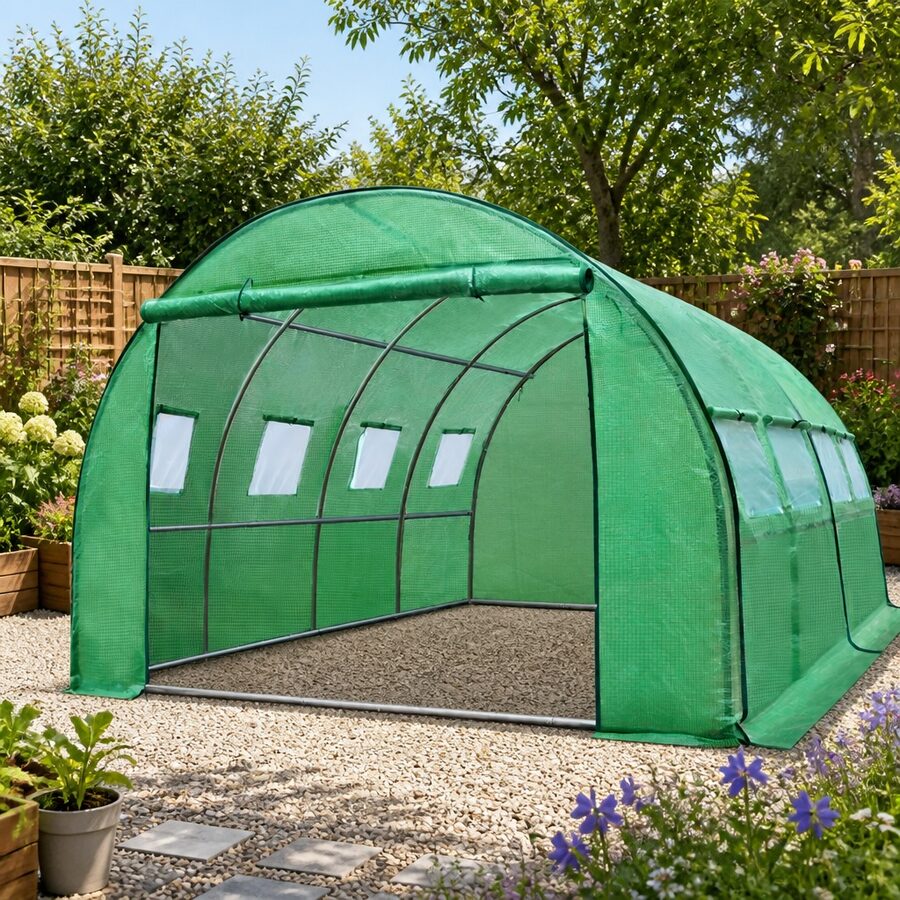
If your yard is more square than long, or you just want to test the idea of greenhouse growing before committing to 22 metres of steel, a shorter tunnel makes more sense. The 4x3x2m Walk-In Tunnel Greenhouse uses the same steel-and-PE construction but in a compact footprint that fits most standard backyards, and it comes with windows built into the cover for cross ventilation, which matters a lot once inside temperatures climb over 30°C in a Melbourne or Brisbane summer.
How the PE cover copes with Australian weather
PE film isn’t glass and it isn’t going to insulate like a double-glazed greenhouse. What it does well is diffuse harsh sun, so plants under it get bright, even light instead of direct scorching rays, and it holds a few degrees of warmth overnight which matters for frost-sensitive seedlings in a Melbourne or Canberra winter.
A few practical notes from having set these up ourselves:
- Tension the cover firmly when you install it — a loose PE sheet flaps in wind and wears through at the friction points within a season. A taut one can last two to three years before it needs replacing.
- Anchor every leg. On a 22m run, wind load adds up along the whole length, so ground stakes or concrete footings at each hoop aren’t optional in an exposed yard.
- Open the end doors or window vents on hot days. Without airflow, a sealed PE tunnel in full sun can hit 45°C+ inside by early afternoon, which will stress or kill seedlings faster than frost would.
- Replace the cover, not the frame, when it eventually degrades from UV exposure. The steel skeleton usually outlasts two or three covers.
What you can actually grow in one
At 44m² split down a 2m-wide tunnel, most households run it as:
- Two garden beds either side of a centre path — good for tomatoes, capsicum, chillies, leafy greens and seedling trays
- Staging shelves down one side for pots, with the other side left as a growing bed
- A propagation section near one door for trays and cuttings, with mature plants further down the tunnel where headroom is greater
It’s a season-extender more than a tropical hothouse — expect to bring your warm-season harvest forward by four to six weeks and stretch it later into autumn, rather than growing bananas in a Tasmanian winter.
If you don’t have the yard space for a tunnel at all
Renters, apartment dwellers, or anyone without a backyard long enough for even the 4x3m version can still grow indoors year-round. A 300x150x200cm Grow Tent Kit uses a similar principle — light-proof fabric over a steel frame — but adds built-in ventilation ports for fans and filters, since there’s no wind outside to move air through it. It’s the indoor equivalent of the same core idea: cheap frame, functional cover, controlled growing environment.

Sizing it up before you buy
Before ordering a 22-metre structure, walk the actual space with a tape measure and mark out 2m width and 22m length with stakes or string. It looks longer in real life than it does in a product photo. Check for overhead power lines, check your fence height for shading, and confirm your council doesn’t require a permit for structures over a certain length in your zone — some do, some don’t, and it varies by council. Once you’ve walked the footprint and it fits, the assembly itself is straightforward: bolt the hoops, run the ridge pole, stretch and clip the cover, peg it down, and you’ve got a season-extending tunnel that’ll outlast a few winters of tomatoes.