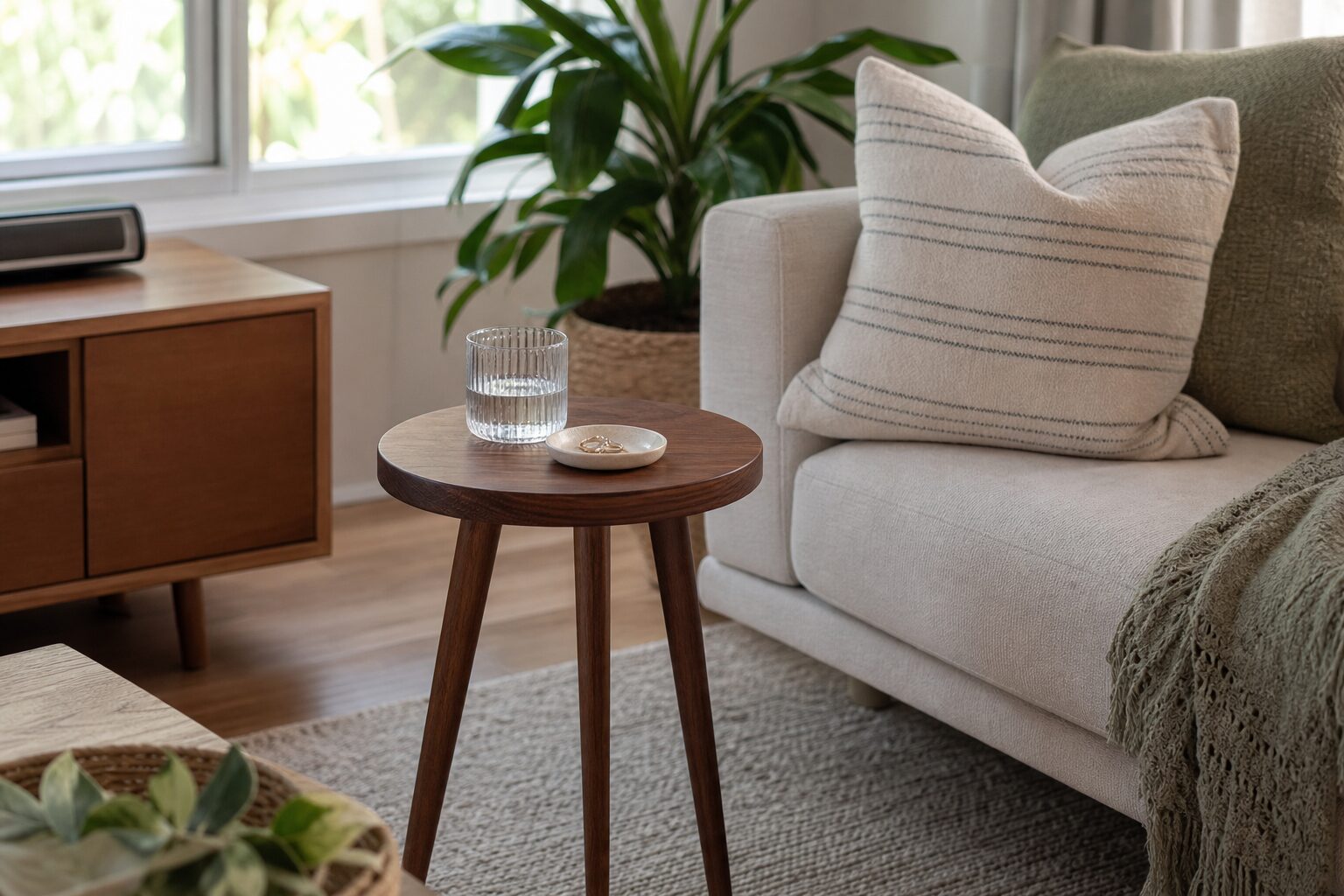
My neighbour asked me last month why anyone would want a table top that’s only 30cm across. “That’s barely bigger than a dinner plate,” she said, holding one up like it was a joke. Three weeks later she messaged me a photo of it sitting on a repurposed steel pipe stand next to her armchair, holding a lamp and a mug of tea. She got it.
A Ø30cm round solid wood table top isn’t trying to be your dining table. It’s a small, honest piece of timber that solves specific problems in specific spots — and once you see where it fits, you start noticing gaps in your own place it could fill.
What a 30cm round table top is actually good for
At this size, you’re not building furniture for a family dinner. You’re building something for one drink, one book, one plant, one lamp. Think of it as a blank slab you finish yourself — the timber does the heavy lifting, you supply the legs, base or bracket.
- Side table for a single armchair — sits low and close, big enough for a coffee cup without eating up floor space.
- Plant stand top — solid wood handles the occasional watering slop far better than veneer or MDF.
- Lamp table in a narrow hallway — where a full-size table would block the walkway.
- Bedside surface — especially in small bedrooms or shared rooms where a standard bedside table won’t fit.
- Stool-height side table on a balcony — pair it with hairpin legs for something that looks intentional, not like leftover furniture.
- Laptop stand for the couch — mounted on an adjustable base, it becomes an impromptu work surface.
- Display stand — for a vase, a small sculpture, a stack of books — anywhere you want a bit of visual height.

Why solid wood beats a laminate top at this size
At 30cm, every knock, every wet glass ring, every dent shows up close because you’re always looking right at it. Laminate chips at the edges and can’t be sanded back. A round solid wood table top in this Ø30cm brown finish can take a light sand and a fresh coat of oil in twenty minutes if it starts looking tired. That’s the whole appeal of solid timber on small furniture — it ages instead of just wearing out.
The brown finish also does something practical: it hides the small scuffs that come from moving a side table around a room, which a pale timber or white lacquer top won’t forgive as easily.
When 30cm is too small (and what to grab instead)
Honestly, if you’re picturing two coffee mugs, a plate of biscuits and the TV remote all at once, 30cm will feel tight. That’s the size where people usually message us asking for a bigger version after the fact.
For anything doing double duty as an actual coffee table or a small desk surface, step up to a Ø70cm solid pine round table top. It’s still small enough for an apartment living room or a reading nook, but wide enough to hold a laptop, a mug and a notebook without things sliding off the edge. Same solid-wood logic, just more real estate.

A quick way to decide which size you need
- Holding one drink and a phone? Ø30cm is plenty.
- Working from the couch or hosting two people for coffee? Go Ø70cm.
- Need something that packs down for the boot of the car? Different category entirely — more on that below.
Building your own base — what actually works
A round wood top this small doesn’t need a heavy base. Overbuilding it defeats the point. A few things that genuinely work:
- Three hairpin legs — light, cheap, and the classic look for a reason. Anything more than three legs on a 30cm top starts looking cluttered.
- A single steel pipe stand — good for plant stands, gives it a slightly industrial, slightly Scandinavian look depending on the finish you pick.
- An old stool base — if you’ve got a wobbly wooden stool with a broken seat, this is often the easiest fix. Screw the top straight onto the stool frame.
- A repurposed tripod camera stand — sounds odd, works surprisingly well for an adjustable-height side table.
Whatever base you choose, pre-drill your screw holes from underneath so you don’t split the timber near the edge — at this diameter there’s not much margin for error.
Care that actually matters at this size
Solid wood at 30cm gets handled more than a big dining table — people pick it up to move it, rest hot mugs directly on it, plants drip onto it. A few habits keep it looking good for years rather than months:
- Wipe spills straight away — timber this thin dries out patchy if liquid sits on one spot.
- Use a coaster for hot drinks; even a sealed finish can mark under sustained heat.
- Re-oil once or twice a year if it’s near a window or gets a lot of sun.
- Felt pads on the base legs stop it scratching floorboards when it gets moved around, which — let’s be honest — a small side table does a lot.
The portable option nobody thinks of
If what you actually want is something for the backyard, camping trips or impromptu gatherings rather than a permanent piece of furniture, a fixed round top isn’t always the answer. This is where the 70cm beer crate tabletop earns its keep — it sits straight on top of a milk crate or beer crate, turns it into an instant table, and packs flat when you’re done. Not solid wood furniture in the traditional sense, but genuinely useful for the same reason a small round top is: it solves one specific problem without asking you to rearrange your whole space.

Small round table tops are one of those things you don’t think you need until you’ve got one sitting exactly where a gap used to be. Start with the size that matches what you’re actually going to put on it — a mug and a phone, or a laptop and a coffee — and build the base to match, not the other way around.