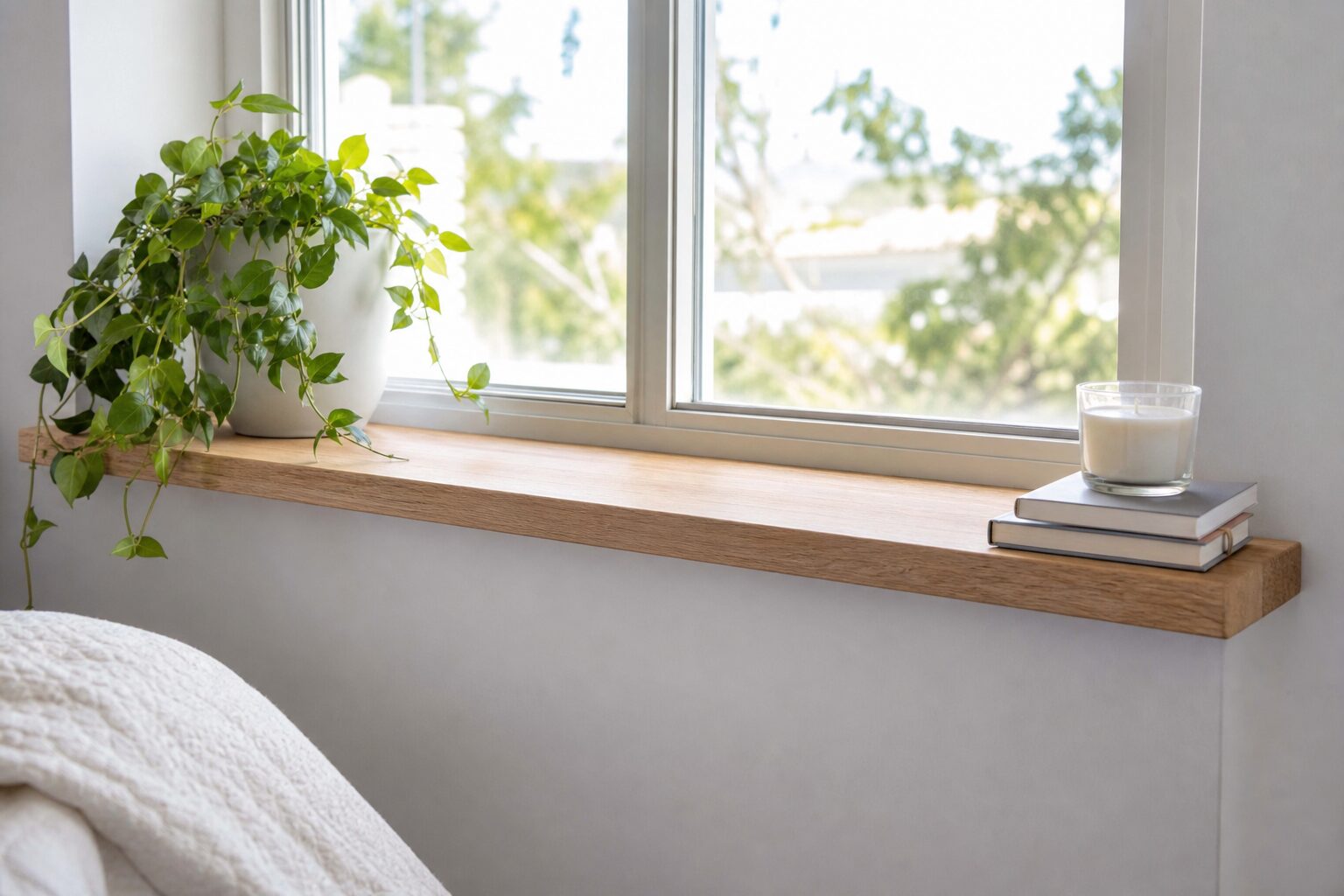
A customer rang the warehouse last winter asking why her painted MDF window sill had gone soft and bubbly along the front edge after one wet Melbourne season. Condensation had been sitting on it every morning for months and the board just couldn’t cope. That call is basically the reason this article exists.
If you’re replacing a tired sill or fitting one for the first time, a solid oak window sill solves most of the problems people don’t think about until they’ve already bought the wrong material. Here’s why we keep pointing customers towards the 100 x 30 x 2 cm solid oak sill in particular.
What you’re actually getting with this oak sill
It’s solid European oak — not an oak veneer glued onto chipboard, not a laminate print. The board measures 100 cm long, 30 cm deep and 2 cm thick, left untreated so the natural brown grain is visible and ready for you to oil, wax or stain to match your own trim. Because it’s genuine timber all the way through, you can cut it to width with a regular saw and the cut edge looks exactly like the face.

Seven reasons it’s worth the upgrade
1. It shrugs off condensation better than manufactured boards
Solid oak has a tight, dense grain structure. It handles the odd bit of morning condensation or a splashed watering can far better than MDF or particleboard, which swell and delaminate once moisture gets into the edges. Oak isn’t waterproof, but it’s genuinely more forgiving.
2. Untreated means you’re in control of the finish
Some people want a raw Scandi look with a matte oil finish. Others want it stained darker to match a jarrah floor or painted white to match the architraves. Because this sill comes untreated, you’re not fighting an existing lacquer or trying to sand off a factory coating first — you just pick your finish and go.
3. It’s thick enough to actually feel solid
At 2 cm thick, this isn’t a flimsy strip. It has enough heft to sit flush in a standard reveal without flexing, and it takes screws or brackets properly if you’re fixing it down rather than just resting it on the sill plate.
4. One size fits most standard openings
At 100 cm long and 30 cm deep, it covers the vast majority of standard Australian window openings with room to trim. If your opening is narrower, cutting oak to length is straightforward with a hand saw or circular saw and a sharp blade — no special tools needed.
5. It works as more than a sill
A 30 cm deep oak ledge is genuinely useful as a display shelf — pot plants, a row of jars, a stack of books, or the cat’s favourite sunny spot. A lot of our customers buy it specifically as a floating display ledge rather than a strict window sill replacement.
6. Natural grain hides everyday knocks
Real timber grain has enough visual texture that small scuffs, a dropped mug ring, or a scratch from a pot base don’t stand out the way they would on a flat painted surface. A light sand and re-oil every year or two keeps it looking fresh.
7. It pairs naturally with a broader timber refresh
If you’re already swapping out old aluminium sliding doors or hollow internal doors for something warmer, an oak sill ties the whole room together. Natural timber tones read as more considered than mixed finishes — a pale oak sill next to a pale sliding door, or a deeper oak stain matched to a walnut-toned door, makes the whole opening look intentional rather than patched together.
Finishing the whole opening, not just the sill
Sills rarely get replaced in isolation — usually it’s part of a bigger tidy-up of a window or an adjoining doorway. If you’re working on a room where space is tight, a solid pine sliding door in natural white (90 x 210 cm) is worth a look — it swaps a swinging door for a space-saving slider without losing the timber warmth an oak sill brings to the room.

For a darker, more grounded look, the natural wood brown sliding door (80 x 210 cm) sits well against an untreated or lightly oiled oak sill — both are raw timber tones, so they age and weather in a similar way rather than clashing over time.

Fitting and caring for it
Before installing, give the sill a light sand with 240-grit paper if you want a smoother finish than it comes with. Apply a Danish oil or hardwax oil in two thin coats, letting each dry fully — this is the single biggest thing that determines how it looks in five years.
- Wipe up spills promptly, especially near the front edge where water pools.
- Avoid placing pots directly on the surface without a saucer — trapped moisture under a pot is the main way any timber sill stains.
- Re-oil once a year in high-use rooms like a kitchen or laundry, every two years elsewhere.
- If it’s in direct sun for hours a day, expect the colour to deepen slightly over time — that’s normal ageing, not damage.
Measure your opening twice before you cut anything — timber only gets shorter once you’ve made the cut, not longer. If in doubt, order the full 100 cm length and trim on site once you can see exactly how it sits in the reveal.