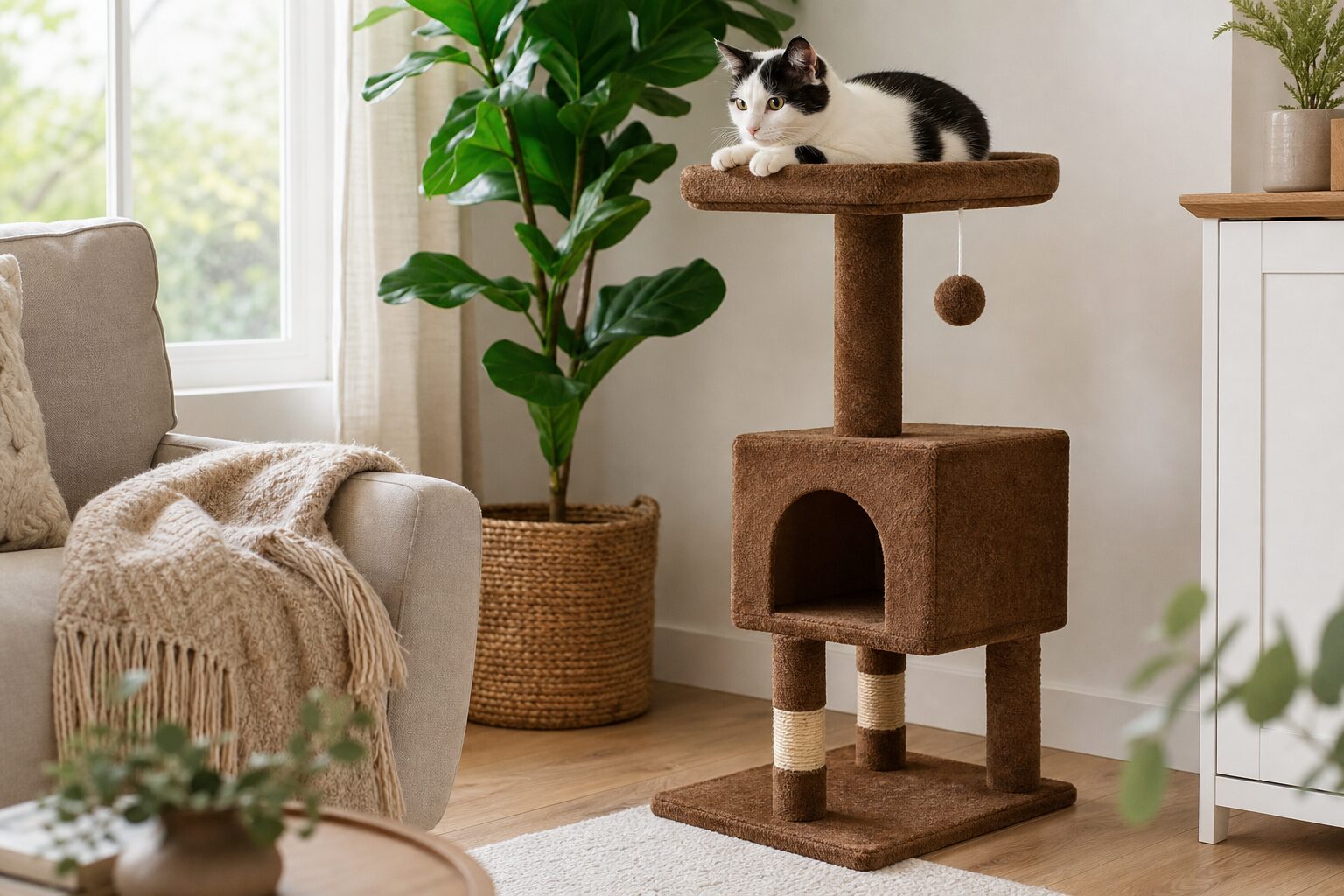
My neighbour’s cat, Biscuit, spent last June sulking behind the washing machine every time the temperature dropped below 12 degrees. Not because she was cold exactly — more that she had nowhere decent to perch that wasn’t a cold tile floor or the top of the fridge, which she wasn’t supposed to be on anyway. Sound familiar? Winter changes what cats want from their space, and most small units and townhouses just don’t have room for the giant carpeted towers you see in pet shop catalogues.
That’s the gap a compact cat tree for small apartments actually fills. You don’t need a five-level monster taking up a corner of the living room. You need something that gives a cat height, a scratching outlet, and a warm perch to nap on — without eating half your floor space.
Why cats want more height and warmth in cooler months
Cats regulate their body temperature by finding warm spots and by curling up tight, which is easier on a raised, enclosed platform than on an open floor. Height also matters psychologically — cats feel safer and calmer when they can see the room from above, which is exactly why so many end up on top of bookshelves or wardrobes in winter. A proper perch gives them that option without the risk of knocking your books off.
Scratching behaviour doesn’t stop in winter either. If anything, indoor cats scratch more because they’re inside longer and getting less outdoor stimulation. A sisal rope post gives claws something to work on that isn’t your couch arm.
What makes this particular cat tree work in small spaces
The Cat Tree Scratching Post Sisal Rope Perch Climb House Platform is built with a small footprint in mind — it’s designed to sit in a corner or beside a couch rather than dominate a room. The sisal rope wrapping on the posts gives cats a scratching surface with real grip, which matters more than people think. Cheap fabric-wrapped posts fray and go slippery after a few months; sisal holds its texture and actually gets more satisfying to claw as it wears in.

The brown tone is a practical choice too. It doesn’t show fur or dust the way white or pale grey trees do, and it sits reasonably well against most Australian living room colour schemes — timber floors, beige rugs, that sort of thing. There’s a covered house section for cats who like to disappear entirely (most do, especially in colder weather) and an open platform up top for the ones who’d rather survey the room.
Placement tips that actually make a difference
- Put it near a window that gets morning or afternoon sun — cats will use a scratching tower far more if it doubles as a sunbaking spot.
- Avoid draughty corners near external doors; even indoor cats feel a cold draught along the floor.
- Leave at least 40-50cm of clearance in front so your cat has a run-up to jump onto the platform.
- If you’ve got carpet, a small offcut of rug underneath stops the base sliding when a cat launches off it enthusiastically.
When a bigger multi-level tower makes more sense
Compact is right for most units, share houses and smaller living rooms, especially with one or two cats. But if you’ve got a household with three or more cats, or cats that squabble over territory, a taller multi-level option gives everyone their own spot instead of one cat guarding the single good perch. The 145cm Tower Scratching Post Condo works well for that — multiple platforms, a proper bed section, and enough height that even a confident jumper gets a workout climbing it. It’s a genuinely different scale of product, so worth thinking about how many cats actually need to use it at once before you decide which size suits your place.

The other winter problem nobody talks about: litter box smell indoors
Cooler weather means windows stay shut more, doors stay closed, and any litter box smell that would normally drift out through an open window in summer just sits in the room instead. If your litter tray lives in the laundry or a corner of the living area, this is the season it becomes obvious to guests before you even notice it yourself.
A Cat Litter Box Enclosure with hidden storage design solves this without moving the tray anywhere inconvenient. It looks like a side cabinet, keeps smell and litter scatter contained, and gives you a flat top surface for a lamp, plants, or a basket of cat toys — genuinely useful in small apartments where every piece of furniture needs to earn its floor space twice over.

A few practical notes on care and assembly
Sisal rope posts don’t need much maintenance — just vacuum the base of the tree occasionally where scratched fibres collect, and rotate the post’s use by placing treats or a toy near it if your cat’s favouring the couch instead. Assembly on compact trees is usually straightforward: base, post sections, then the platform and house piece screw together with the included hardware. Most people manage it in fifteen to twenty minutes without tools beyond what’s supplied. Stand the tree on a hard or low-pile surface where possible — deep shag rugs can make the base feel less stable than it actually is.
Biscuit, for what it’s worth, eventually got a similar setup and moved off the top of the fridge within about two days. Cats notice a good perch fast. If your lounge room’s been colonised by fur on the good cushions this winter, a scratching post with a proper platform is usually the cheaper fix — and it’s a lot easier to vacuum than a couch.